
Video booklet 4.3/5/7 inch IPS screen

Description
This video booklet was made with a 7 inch screen and 1 GB of memory - printed to order and loaded with the client's film.
The product
This page does not show a single client project but the decision that stands at the beginning of every video card: how big the screen should be. Three sizes are built in most often, 4.3 inch, 5 inch and 7 inch, and they differ less in their technology than in the effect they have on the page.
Technically the three versions are close to one another. All of them work with an IPS screen, sound at 44 kilohertz, a memory of 1 gigabyte, which corresponds to around twenty minutes of HD video, and a magnetic catch that starts the film when the card is opened. Charging and loading run through the same USB port. The whole booklet is printed in four colours and given a matt lamination. Buttons are possible but not obligatory: volume up, volume down, play and pause, and chapter selection on request.
The difference lies in the ratio of screen to paper. At 4.3 inch most of the inside page stays printed, 7 inch reverses the ratio, and 5 inch sits in between, which is why it is chosen most often.
What it is made for
The choice of size follows the route the promotional piece takes. If the card is to go out by post in a larger run, then weight, thickness and cost per unit are what count, and the compact version comes out ahead. If it is handed over in a meeting, pressed into someone's hand at a trade fair or enclosed with a quotation, the screen may be larger, because several people often watch at the same time.
Just as important is what there is to see. A face that speaks carries even on a small surface. A film with figures, plans or machines needs room, otherwise the recipient has to hold the card close to the eye.
How we built it
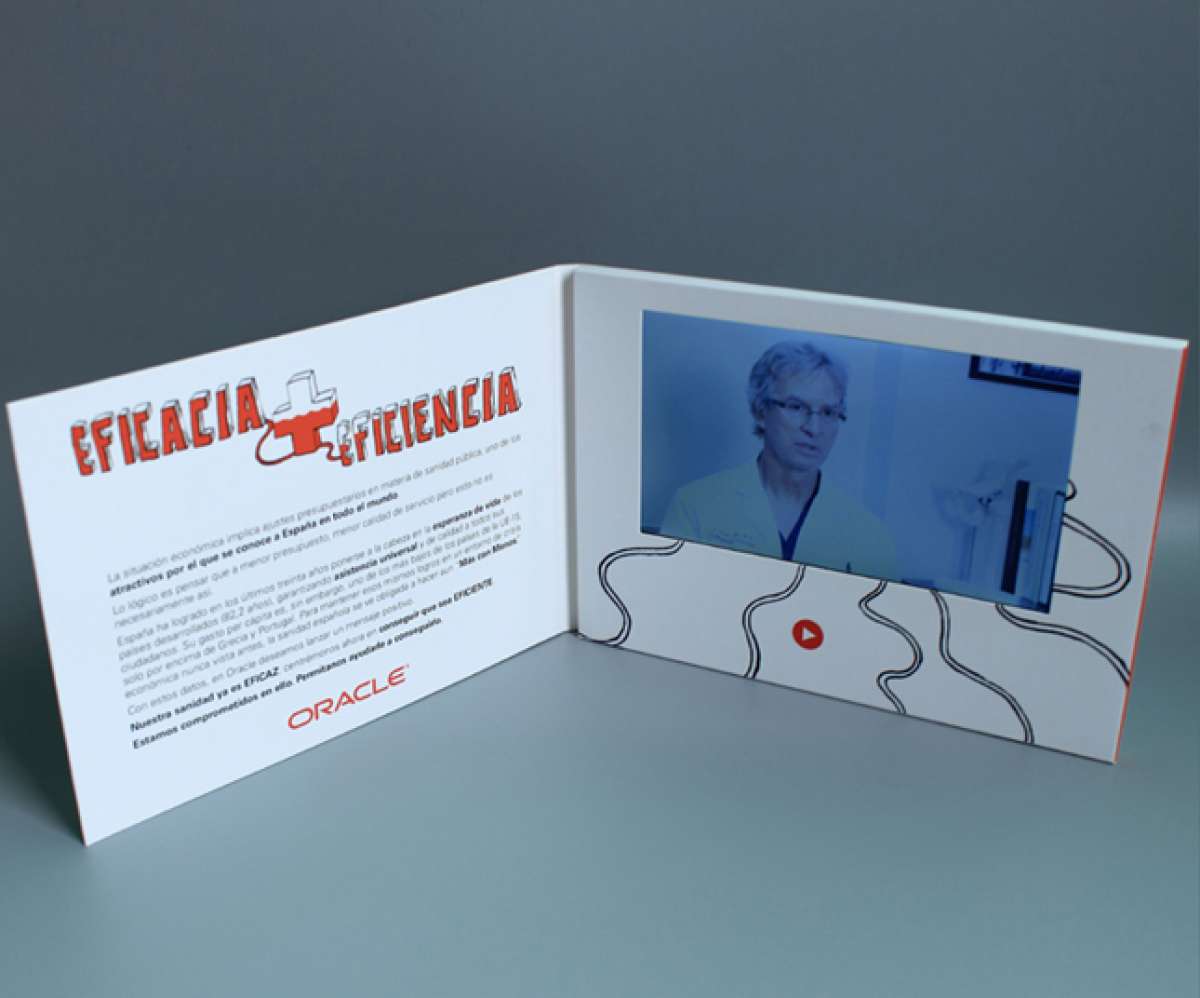
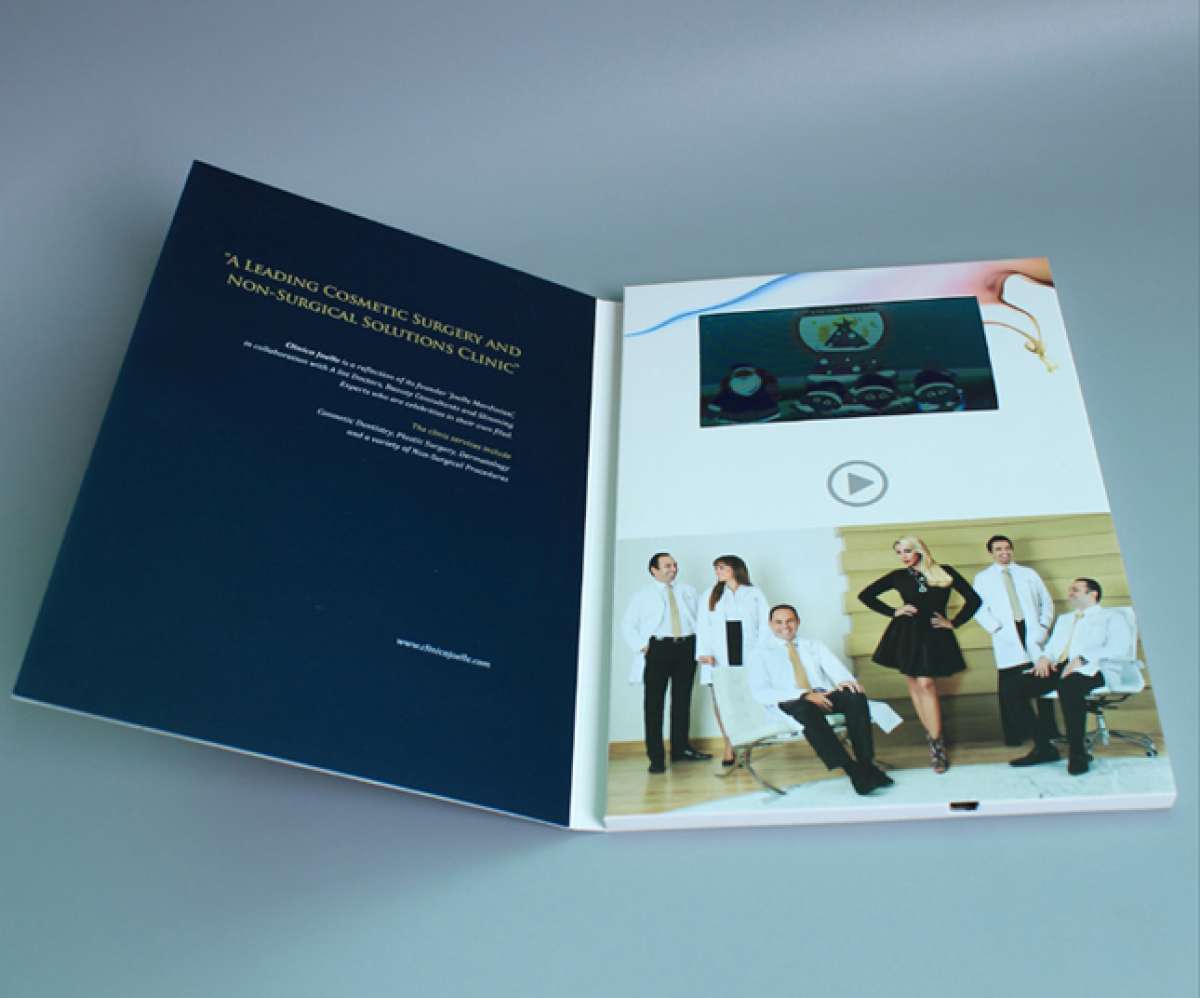
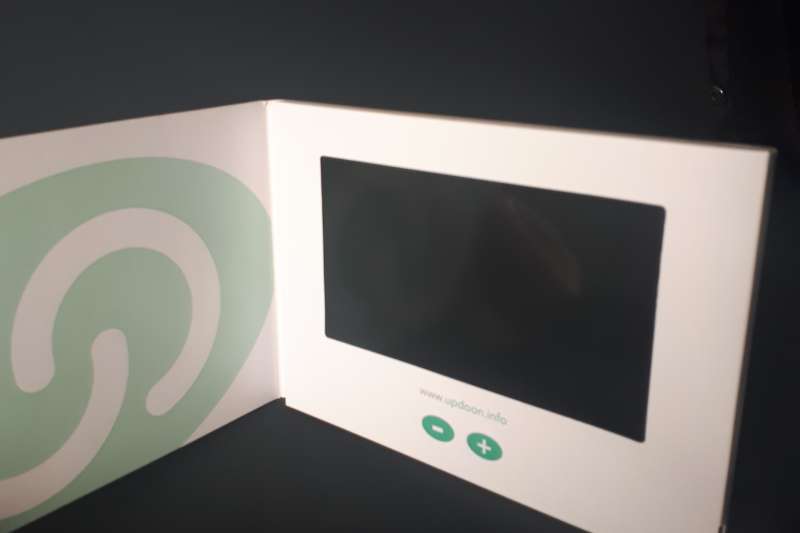
The photographs show what these differences mean in the design. On a landscape booklet with a small screen, the left inside page remains a fully written text field with a heading and a sender, while the screen on the right sits inside a drawn field of lines with a single round play button below it. On a portrait example the screen sits in the upper third, with a play symbol and a full-page photo sequence running on below.
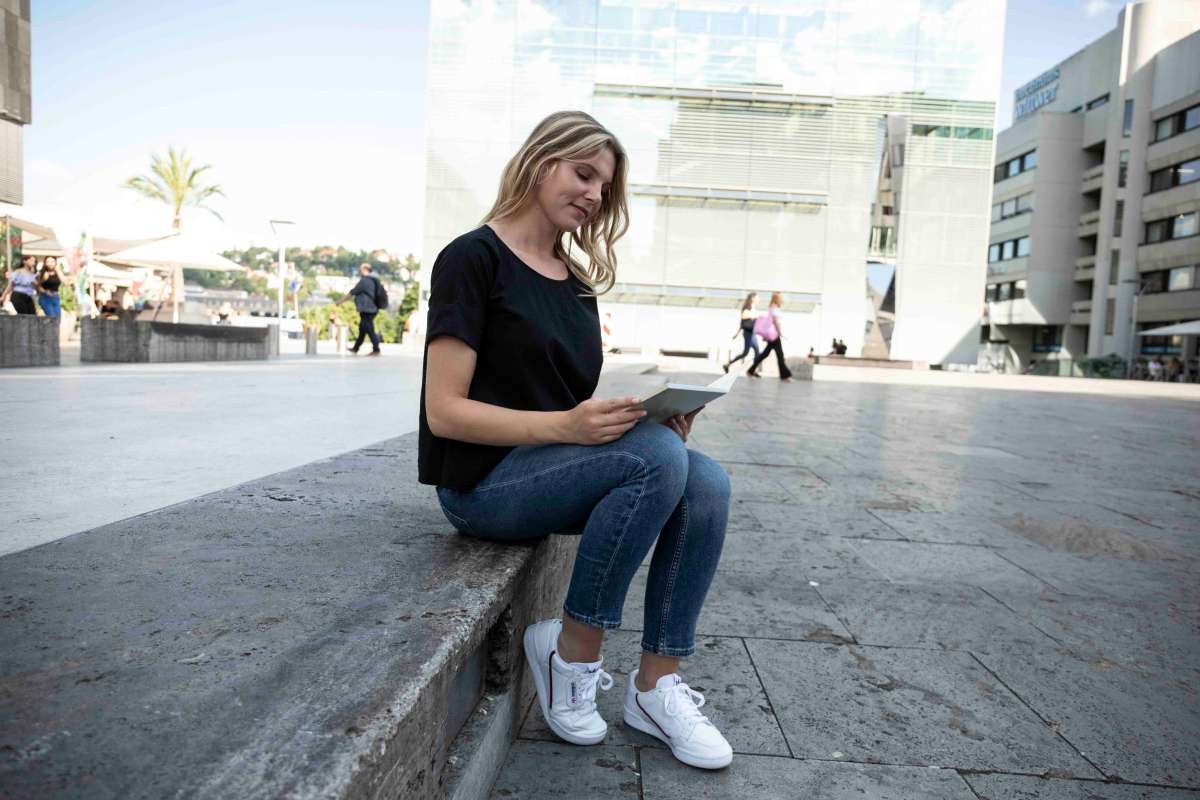
Another picture shows the card being used away from the desk: open in both hands, outdoors, with no headphones and no device beside it. A fourth photograph shows the other state, the card with the cable at the computer. That port both charges the battery and loads the film, as often as you like.
Formats and colours are not tied to the screen size. Landscape or portrait, A5 or a special size, light or dark board: the mechanism stays the same, and the blank is cut afresh for every run.
Why a video booklet
- The film plays with no detour. No app, no code, no network: opening the card is enough, and picture and sound come out of the paper.
- Size is a design decision. At 4.3 inch the page stays a printed piece with a film, at 7 inch it becomes a screen with a frame.
- Smaller also means lighter. For a larger postal mailing, the compact screen is the calmer route.
- The technology stays the same. Memory, magnetic catch, sound and USB port do not change with the screen size.
- Nothing is final. The film can be swapped later while the printing stays as it is.
The same for your company
Production starts at 100 units, and depending on size, memory and finish the price lies between 20 and 50 euros per card; for small runs there are one-off setup costs for printing and the cutting die on top. What each option does is set out on the Prices page. If you are torn between two sizes, we will send a sample, and the question is usually answered the moment it is opened.
Technical data
Memory: 1 GB
Audio: 44 kHz
various
HD screen sizes
available
a wide range of
product formats
available
Magnetic closure starts the film on opening
Buttons are optional, for example volume up and down or play and pause
4-colour printing, matt lamination
USB port for charging and loading new content
Important:
vlyer video booklets carry the WEEE, RoHS and CE certification required by law. Without these certificates the cards may not be placed on the market in Germany, and the penalties are steep.
Ask for your own quote
Tell us the quantity and the screen size, we will work out the rest together.